
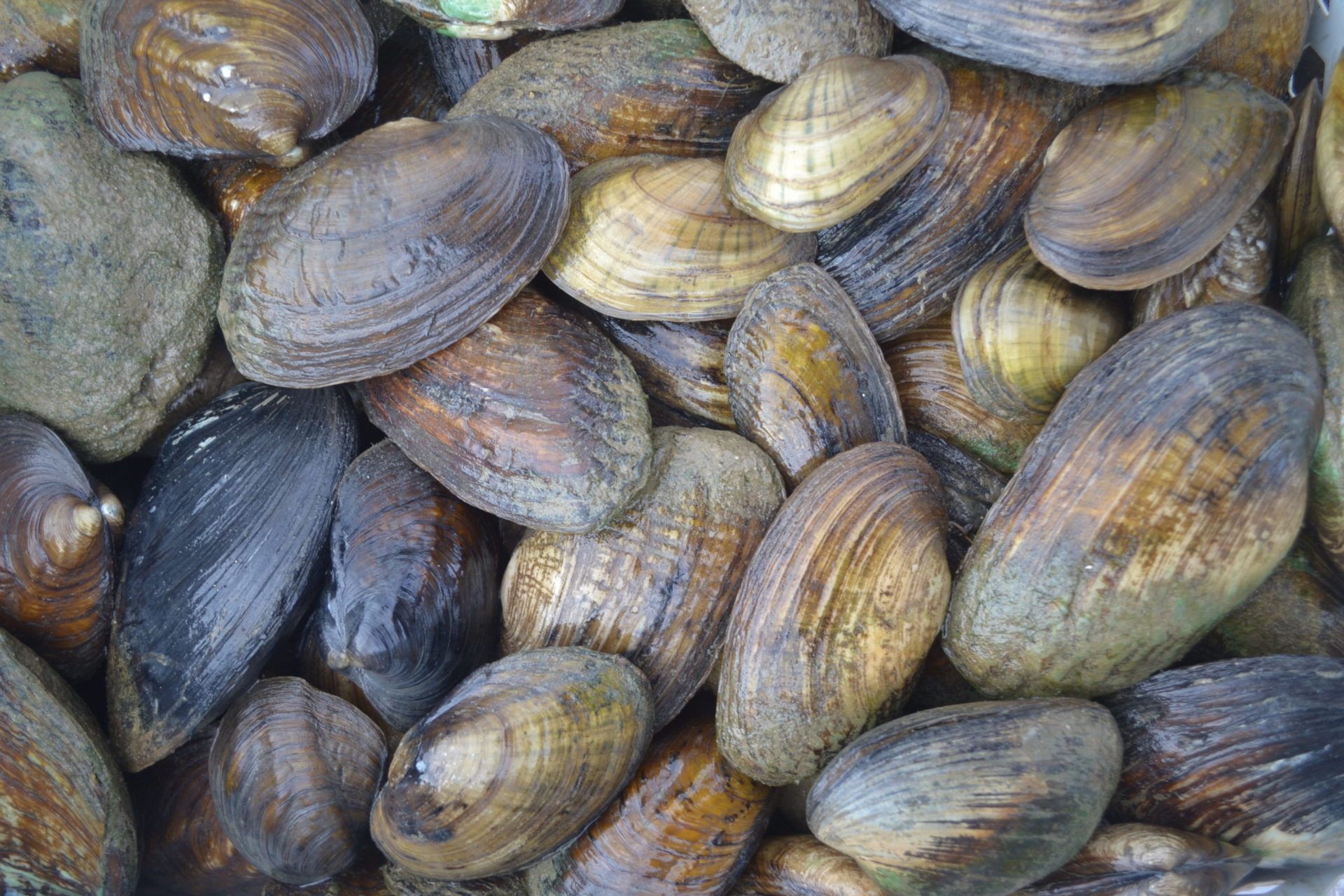
Freshwater Mussels of the Ohio River
Have you ever seen a purple wartyback? How about a pyramid pigtoe? Or a monkeyface? These colorful and sometimes comical names belong to our nation’s freshwater mussels. These animals are our rivers’ natural filters, constantly straining the water and removing particles which they consume as food, leaving the water cleaner. They are long-lived (some to 100 years), slow growing, and move very little during their lives, serving as excellent indicators of aquatic health. They are also food for other animals. Over the centuries, people have harvested mussels as food, tools and ornamentation, and more recently, for the manufacture of pearl buttons and cultured pearls.
At the turn of the century, the Ohio River basin was home to 127 of the 297 freshwater mussel species native to North America. Since that time, however, human changes in the environment have taken their toll: 11 mussel species are extinct, and 46 others are classified as endangered or species of concern. Over the past 200 years, we have abused our aquatic ecosystems through pollution, dam construction, stream channelization, dredging, clearing of riparian vegetation and discharge of mining and industrial wastes. Add to this the introduction of exotic species like the zebra mussel, and you have a recipe for extinction.
Following is a list of the native mussel species known to inhabit the Ohio River, either historically or currently:
| Common Name | Scientific Name |
| Spectaclecase R | Cumberlandia monodonta |
| Mucket | Actinonaias ligamentina |
| Threeridge | Amblema plicata plicata |
| Flat floater | Anodonta suborbiculata |
| Rock-pocketbook | Arcidens confragosus |
| Purple wartyback | Cyclonaias tuberculata |
| Fanshell E | Cyprogenia stegaria |
| Butterfly | Ellipsaria lineolata |
| Elephant-ear | Elliptio crassidens |
| Spike | Elliptio dilatata |
| Leafshell X | Epioblasma flexuosa |
| Forkshell X | Epioblasma lewisii |
| Purple catspaw E R | Epioblasma obliquata obliquata |
| White catspaw E R | Epioblasma obliquata perobliqua |
| Round combshell X | Epioblasma personata |
| Tennessee riffleshell X | Epioblasma propinqua |
| Wabash riffleshell X | Epioblasma sampsonii |
| Northern riffleshell E R | Epioblasma torulosa rangiana |
| Tubercled blossom E R | Epioblasma torulosa torulosa |
| Snuffbox R | Epioblasma triquetra |
| Ebonyshell | Fusconaia ebena |
| Wabash pigtoe | Fusconaia flava |
| Long-solid | Fusconaia subrotunda |
| Cracking pearlymussel E R | Hemistena lata |
| Pink mucket E | Lampsilis abrupta |
| Plain pocketbook | Lampsilis cardium |
| Wavy-rayed lampmussel | Lampsilis fasciola |
| Pocketbook | Lampsilis ovata |
| Fatmucket | Lampsilis siliquoidea |
| Yellow sandshell | Lampsilis teres |
| White heelsplitter | Lasmigona complanata complanata |
| Fluted-shell | Lasmigona costata |
| Fragile papershell | Leptodea fragilis |
| Scaleshell E R | Leptodea leptodon |
| Black sandshell | Ligumia recta |
| Washboard | Megalonaias nervosa |
| Threehorn wartyback | Obliquaria reflexa |
| Hickorynut | Obovaria olivaria |
| Ring pink E R | Obovaria retusa |
| Round hickorynut | Obovaria subrotunda |
| White wartyback E R | Plethobasus cicatricosus |
| Orange-foot pimpleback E | Plethobasus cooperianus |
| Sheepnose | Plethobasus cyphyus |
| Clubshell E | Pleurobema clava |
| Round pigtoe | Pleurobema coccineum |
| Ohio pigtoe | Pleurobema cordatum |
| Rough pigtoe E R | Pleurobema plenum |
| Pyramid pigtoe | Pleurobema pyramidatum |
| Pink heelsplitter | Potamilus alatus |
| Fat pocketbook E | Potamilus capax |
| Pink papershell | Potamilus ohiensis |
| Kidneyshell | Ptychobranchus fasciolaris |
| Giant floater | Pyganodon grandis |
| Rabbitsfoot | Quadrula cylindrica cylindrica |
| Winged mapleleaf E R | Quadrula fragosa |
| Monkeyface | Quadrula metanevra |
| Wartyback | Quadrula nodulata |
| Pimpleback | Quadrula pustulosa pustulosa |
| Mapleleaf | Quadrula quadrula |
| Creeper | Strophitus undulatus |
| Lilliput | Toxolasma parvus |
| Texas lilliput R | Toxalasma texasensis |
| Pistolgrip | Tritogonia verrucosa |
| Fawnsfoot | Truncilla donaciformis |
| Deertoe | Truncilla truncata |
| Pondhorn | Uniomerus tetralasmus |
| Paper pondshell | Utterbackia imbecillis |
| Rayed bean R | Villosa fabalis |
| Rainbow | Villosa iris |
| Little spectaclecase R | Villosa lienosa |
X = presumably extinct
E = federally endangered
R = extirpated from the Ohio River

